
How Much Does a House Renovation Cost in London? A 2026 Homeowner's Guide
If you're thinking about renovating your London home, the first question you'll inevitably ask is how much is this actually going to cost? It's also the hardest question to answer honestly. The truth is, no two renovations are the same — and the price of refurbishing a Victorian terrace in Fulham will look very different to a mansion flat in Chelsea or a Georgian townhouse in Kensington.
At Avalon Projects, we've been designing, managing and building luxury home refurbishments across London for two decades. In that time, we've seen renovations come in at every conceivable budget — and we've seen exactly where homeowners save money and where they unexpectedly overspend.
This guide walks through what really shapes the cost of a London renovation in 2026, so you can budget with confidence and avoid the most common pitfalls.

What Drives the Cost of a London Renovation?
There's no single price for a renovation because the cost is driven by a handful of variables, each of which can move the total significantly. Understanding these levers is the first step to budgeting realistically.
1. The Scope of Work
The biggest single factor is, of course, what you're actually doing. A single bathroom refurbishment sits at one end of the spectrum. A full house renovation involving structural work, a new kitchen, multiple bathrooms, bespoke joinery and a basement dig sits at the other. Within those extremes, the scope is endless — and small additions can have a big impact on the total.
A useful rule of thumb: the more rooms you renovate at once, the better the value per square metre. A single-room project carries more fixed overhead than a whole-house refurbishment delivered as one coherent build.
2. The Property Itself
Period properties — Victorian terraces, Georgian townhouses, Edwardian semis — are beautiful, but they tend to cost more to renovate than modern builds. Why? Because they hide surprises behind every wall: outdated electrics, decaying plumbing, asbestos in older insulation, sagging joists, damp behind original plaster. None of this is a reason not to renovate, but it does mean your budget needs a contingency for the unknown.
A modern flat, by contrast, is often more predictable in cost — but rarely as rewarding to live in once finished.
3. The Spec and Finish
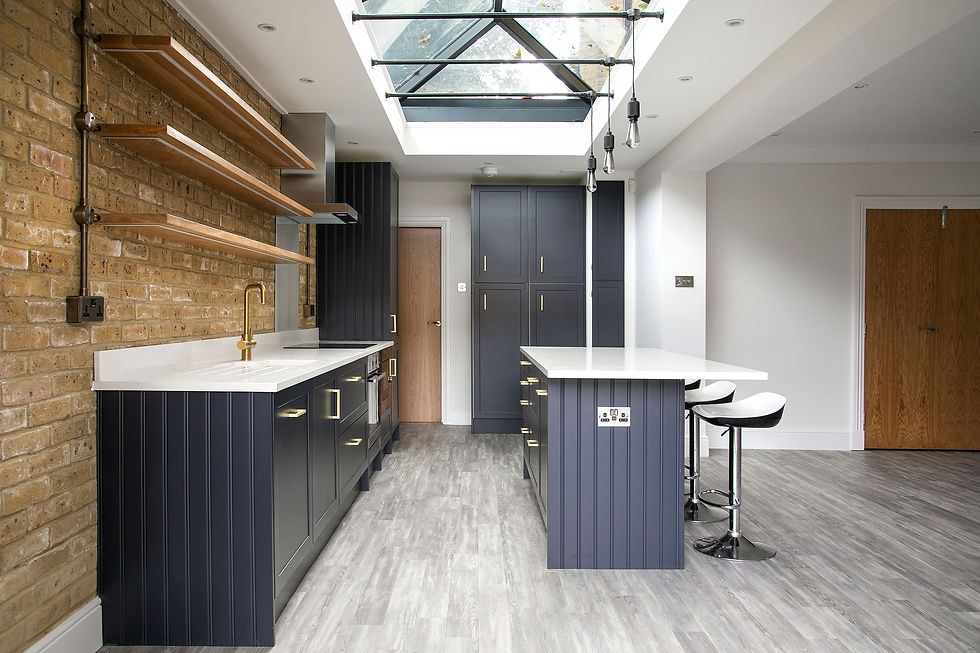
This is where the cost spectrum really widens. The same kitchen layout can cost anywhere from a fraction of the budget to a substantial chunk of the entire renovation, depending on the cabinetry, worktops, appliances, lighting and hardware. The same bathroom can be perfectly functional with off-the-shelf fixtures, or genuinely transformational with bespoke marble, brass and underfloor heating.
Most of our Chelsea, Kensington and Fulham clients sit firmly in the luxury bracket — they want their finished home to look beautiful, last for decades and reflect the value of the property itself. That choice naturally lifts the budget, but it also protects the long-term value of the home.
4. The Area You Live In
London is not one market — it's many. Renovations in prime central postcodes such as SW3, SW6, W8 and SW7 tend to carry a higher overall cost than equivalent projects in outer London. Part of this is access (parking, narrow streets, conservation restrictions, party wall agreements), and part is the higher specification of finishes that prime central homeowners typically choose.
It's also worth knowing that listed buildings and conservation areas come with additional planning requirements that can stretch both the timeline and the budget. Knowing this up front prevents nasty surprises later.
5. Structural and Planning Work
If your renovation involves removing a load-bearing wall, adding a side return, digging out a basement, or extending into the loft, you're moving from a refurbishment into structural territory. This brings architects, structural engineers, party wall surveyors and planning applications into the picture — all of which add to the total cost but also significantly increase the value and liveability of the home.
Where Homeowners Most Often Overspend
After 20 years of luxury renovations across London, we see the same handful of budget pitfalls repeatedly. Knowing them in advance is the single best way to keep your project on track.
1. Changing the design mid-build. Every change after work has started costs significantly more than the same decision made at the design stage. Locking the design in before the build begins is the cleanest, cheapest way to renovate.
2. Underestimating the spec. Homeowners often plan a budget based on the structural work and forget that finishes — tiles, taps, lighting, paint, ironmongery — can easily account for a third of the total. Building a realistic specification before committing to a contractor avoids this.
3. Not budgeting for the surprises. With a period property, something will almost always be uncovered behind the walls. A sensible contingency of around 10 to 15 per cent of the total budget protects you when it does.
4. Paying upfront. Some contractors ask for very large upfront payments — sometimes 60-70 per cent before any work begins. This is one of the biggest financial risks in a renovation. Milestone-based payments, where you only pay as key stages are completed, are a far safer way to fund the project.

How to Budget Realistically
The honest answer to "how much will my renovation cost?" is: get a proper, itemised estimate from a reputable design and build company who has visited the property. Online calculators and rough per-square-metre figures can be a useful starting point, but they cannot account for the specifics of your home, your specification or your area.
A few practical tips before you start the conversation:
Know your priorities. Be clear with yourself about what matters most — the kitchen, the bathrooms, structural changes, the finishes. This helps a good contractor allocate your budget where it will have the biggest impact.
Talk to more than one company. Get three quotes. If one comes in significantly cheaper, ask why — it usually points to a lower spec or hidden costs that will appear later.
Check for transparency. A good renovation company will break down the estimate into design, labour, materials and timeline. If you can't see where the money is going, that's a warning sign.
Confirm insurance and warranty. Make sure the company is fully insured and offers a workmanship warranty (12 months is standard, longer is better).
Why a Design, Manage, Build Approach Saves Money in the Long Run
One of the biggest reasons renovations go over budget is the gap between design and construction. When designers, project managers and builders are separate, decisions get lost in translation — and changes happen mid-build that cost a fortune to put right.
At Avalon, we design, manage and build every project entirely in-house. That means one team from the first sketch to the final finish, one point of contact, and no costly handovers along the way. It's how we keep luxury renovations on time, on budget and free of nasty surprises.

Ready to Plan Your London Renovation?
Every renovation is unique, and the best way to understand the cost of your specific project is to talk to a specialist. Avalon Projects has been delivering luxury refurbishments across Chelsea, Kensington, Fulham and the wider London area for over 20 years, with milestone-based payments, full insurance and a 12-month workmanship warranty as standard.
If you're thinking about a renovation in 2026, we'd be delighted to talk it through with you. Get in touch for a free, no-obligation estimate — we'll listen to what you're trying to achieve, share what's realistic for your home and budget, and give you an honest, transparent picture of what your project would look like.


Comments